
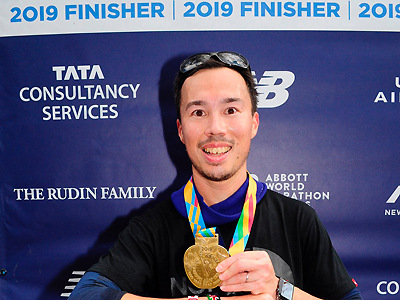
Sports Migration: A Cultural Exploration
People across the globe migrate for a number of reasons. Some move due to poverty and low income, high unemployment rates, persecution and poor human rights, internal conflict and war, climate change, gender inequality, and lack of access to competent healthcare and education. Others go overseas to improve their language ability, acquire new skills, improve prospects for career advancement, and make more money, realizing their visions of a better life for themselves and their families. One’s age, gender, health, social class, language, religion, social norms, race, and ethnicity are all interconnected. When I study about the movement of people, I particularly focus on the trajectories of athletes (men and women) in a certain sport, going from one nation to another. By doing so, I can learn not only what an opportunity through sport means for a particular individual from a certain country, but also what it means to many others in their homeland whose hopes for a better life are attached to them. Sports migration is a lens to understanding what an opportunity abroad represents for people who aim for a temporary, and sometimes permanent separation from their place of origin. We can also better understand the cultures of the countries the athletes are moving between. Moreover, by examining how the people who move find meaning out of their own journeys, we can also be reflective and consider what a meaningful life and better future means for ourselves.
My doctoral research at the University of Amsterdam focused on Kenyan distance runners in Japan, and my current research here at Shizuoka University is about naturalization and professional basketball players from the United States of America and countries in Africa in the Japanese B. League.
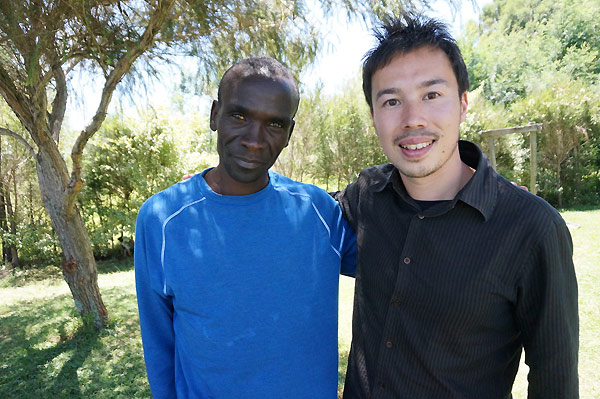
Talking with Eliud Kipchoge, a gold medalist at the Rio de Janeiro and Tokyo Olympics, at his training camp in Kaptagat, located in western Kenya.
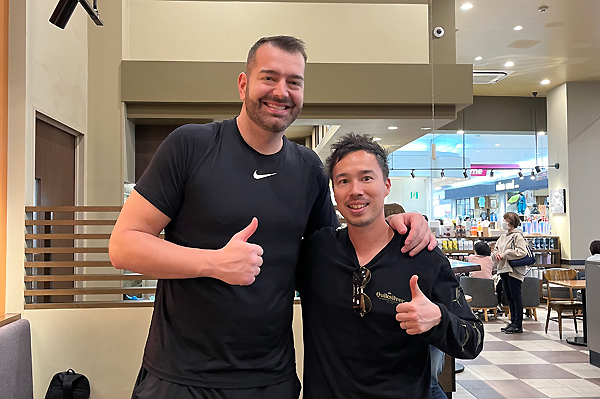
Enjoying the time with Josh Harrellson, who has experience playing for the Japanese National Team, and on multiple teams in both the NBA and Japanese B.League.
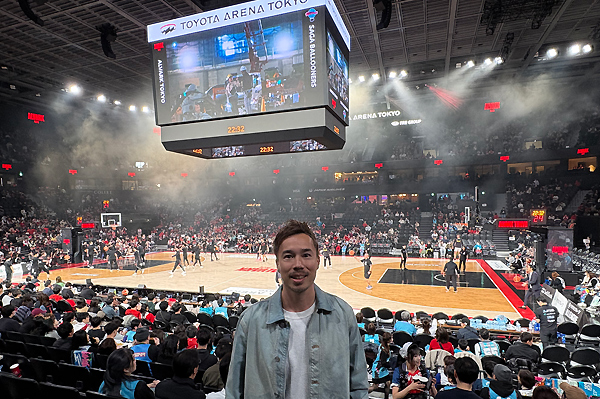
Games in the Japanese B.League are a fascinating experience and true intersection of the global and local.
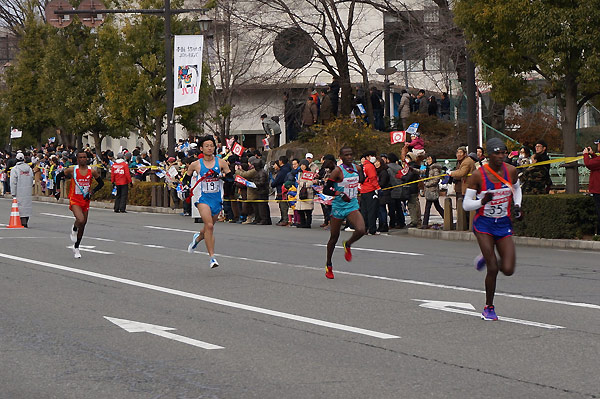
Kenyan runners representing their corporate teams at the annual New Year Ekiden relay race held in Gunma Prefecture.
Global Studies
I teach this course using a mix of English and Japanese, adjusting to the level of understanding and communication ability of the students when studying about a particular theme. Each week, we change the subject of discussion, which almost always features looking for similarities and differences between Japan and the global. Some of the topics covered over the 15 week course include: Convenience Store Culture, Tipping Customs, Artificial Intelligence (AI) in Interpreting and Translation, Book Banning, Tattoos, Digital Music and the Global Music Market, Hip-Hop, Sports Migration, Citizenship, the Taxi Industry, Female Driving in the Middle East, Cultural Meanings of National Holidays, and Graffiti. The course has a few primary goals: widening our perspectives on these topics and understanding them from the viewpoint of people in other countries, considering them within our own life experiences and how discussions about these topics are perceived in our home countries, building friendships with classmates and students outside the class from other countries who are studying at Shizuoka University, and developing more confidence to communicate in both English and Japanese about these global topics. I enjoy this class the most because I feel like I am also a student learning many new things.
Message to prospective students
If a baseball player hits .300 (in baseball, .300 = three hundred = 30%), they are considered a superstar. They make mistakes 70% of the time, and they are considered successful. Don’t be afraid to make mistakes and be confident!